

Casino licences, decoded one regulator at a time
In short
- A licence tells you who can act when something goes wrong. Some regulators can do much more than others.
- Curaçao rebuilt its system: old sublicence numbers stopped being valid in October 2025.
- Anjouan licences are disputed by the Comoros government itself, as of November 2026.
- Always check the number on the regulator's own register, never only the casino footer.
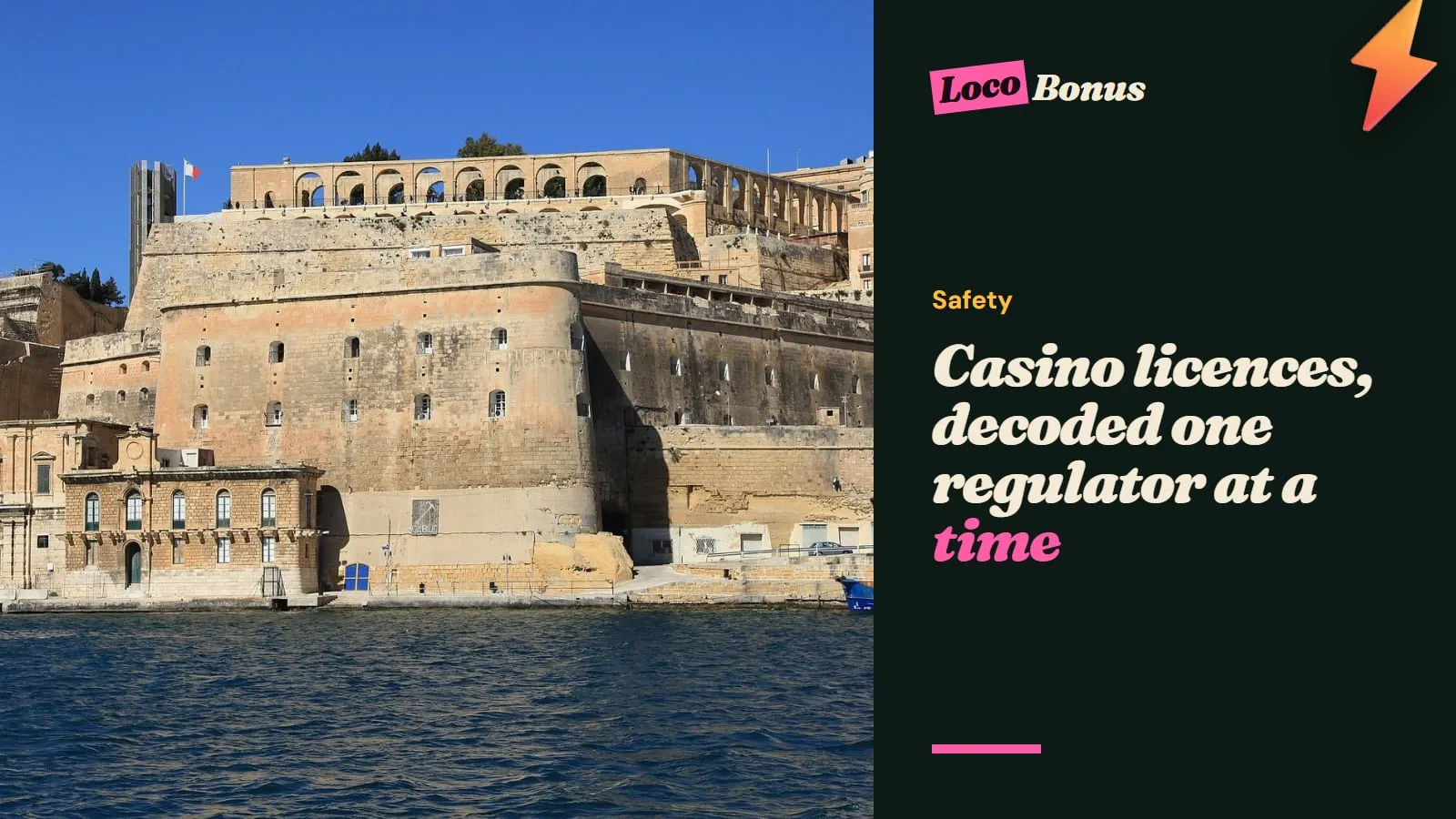
Every casino footer shows a licence. What that licence is worth varies enormously. Some regulators run public registers, force casinos to keep your money separate and give you a route to complain. Others do little beyond collecting a fee. This guide explains what each of the licences you will see on LocoBonus means for you, and how to check one in two minutes.
What a licence does for you
A licence matters when something goes wrong: a withdrawal stalls, a bonus is voided, an account is closed. The questions that count are:
- Is there a public register where you can confirm the licence exists?
- Must your balance be protected if the operator gets into trouble?
- Is there a complaint route beyond the casino’s own support team?
- Can the regulator act, by fining, suspending or revoking?
| Regulator | Public register | Player funds rule | Complaint route | Our tier |
|---|---|---|---|---|
| Malta Gaming Authority | Yes, searchable | Yes | ADR, plus regulator reports | Top |
| UK Gambling Commission | Yes, searchable | Yes, rating disclosed | Approved ADR | Top |
| Isle of Man GSC | Yes, licence-holder list | Yes | Regulator complaint form | Top |
| Kahnawake Gaming Commission | Yes, permit list | Not confirmed | Regulator, after the operator | Middle |
| Curaçao Gaming Authority | Yes, PDF register | Yes, segregated | Free ADR, operator pays | Entry level |
| Anjouan | Disputed | Not published | None found | Bottom |
The tier column is our editorial view, used in how we score casinos. It is not an official ranking. Gibraltar and Estonia are covered below but left out of the table, because we have not confirmed each of their rules from the regulators’ own pages.
Malta Gaming Authority (MGA)
The MGA licenses a large share of European-facing casinos. Its rules require casinos to report on player funds and keep enough to pay what they owe. Disputes go first to the casino, then to an alternative dispute resolution (ADR) body based in the EU or EEA. The MGA itself still takes reports of unfair conduct. Licences are listed on the MGA licensee register, searchable by company, website or status.
UK Gambling Commission (UKGC)
The UKGC regulates gambling for players in Great Britain. A UKGC licence covers British customers only, so a brand’s international site may run under a different licence. Licensed operators must say in their terms how well your balance is protected: not protected, medium or high. The UKGC public register can be searched by business name, trading name, domain or account number, and shows status and any regulatory action.
Gibraltar
Gibraltar licenses online operators through its Gambling Commissioner. Brands that hold a Gibraltar licence often hold a UK licence as well, for their British customers. Start from the Gibraltar gambling regulator’s site and confirm the company name matches the one in the casino’s terms.
Isle of Man Gambling Supervision Commission
The Isle of Man GSC licenses online operators under its online gambling law, and its regulations require operators to protect players’ money. It publishes lists of current and former licence holders. If you live outside the UK and a GSC-licensed casino doesn’t resolve your complaint, the GSC accepts complaints through its own form. The Isle of Man Government’s GSC page is the place to start.
Estonian Tax and Customs Board (EMTA)
Estonia licenses gambling through EMTA, its tax and customs authority. An EMTA licence means an EU-based regulator, which in some countries can affect how winnings are taxed. Check the operator on EMTA’s own site. If you cannot match the company name there, treat the claim as unconfirmed.
Kahnawake Gaming Commission (KGC)
The KGC regulates online gaming from the Mohawk Territory of Kahnawà:ke in Canada and has done so since 1999. Its rules set the minimum age at 18 or your local legal age, whichever is higher. A casino must decide a dispute within 45 days. If you are still unhappy, you can take it to the KGC within six months. One request to the KGC can also exclude you from every operator it authorises. The KGC permit-holder list shows operators and website addresses, but not permit numbers, so match the domain you are playing on.
Curaçao Gaming Authority (CGA)
Curaçao used to work through a handful of private master licence holders, who issued sublicences to casinos. That system is gone:
- November 2023: the regulator, then called the Gaming Control Board, began issuing licences directly. These carry numbers starting OGL/2023/ or OGL/2024/.
- December 2024: a new gambling law came into force. The regulator now operates as the Curaçao Gaming Authority.
- October 2025: the old sublicences expired. A number in the old style, such as 8048/JAZ, no longer means a valid licence.
Current licences require player funds in a segregated account, games certified by an approved testing lab, a CGA seal on the site and free independent dispute resolution paid for by the casino. The register is a PDF linked from the CGA’s licence registry page. Look for the status next to the number. “Indefinite” is a full licence. “Assessment in progress” means the application is still under review, so we describe it that way rather than as fully licensed. The CGA also publishes an enforcement register of revoked licences.
Anjouan
Anjouan is one island of the Union of the Comoros. Its licences carry numbers starting “ALSI-” and have grown fast, with well over a thousand holders. As of November 2026, the Comoros central bank calls the regime illegal and the government has asked for outside help against it. We found no published player-funds rules and no public complaint service. We show these licences as stated, but we don’t treat them as player protection.
How to check a licence yourself
- Find the number and company in the casino footer or terms.
- Open the regulator’s register directly, by typing its address or using the links above, not by clicking the seal. A fake seal can link anywhere.
- Match three things: the company name, the licence number and the exact domain you are playing on.
- Check the status: active, suspended, expired, revoked or under assessment.
- If anything doesn’t match, play elsewhere.
A licence is the first check, not the only one. Our safe casino checklist covers the rest, and every casino in our casino lists shows its stated licence on the card.
Questions players ask
Which casino licence is the strongest for players?
In our scoring, the Malta Gaming Authority, the UK Gambling Commission and the Isle of Man sit at the top: public registers, set complaint routes and player-funds rules. Kahnawake comes next, a current Curaçao licence after that, and Anjouan last.
Is a Curaçao licence still worth anything?
A current one is worth more than it used to be. Since the reform, the Curaçao Gaming Authority licenses operators directly and requires segregated player funds, certified games and free dispute resolution. Old numbers in the 8048/JAZ style are no longer valid.
Where do I find a casino's licence number?
Usually in the footer of every page and in the terms and conditions, together with the company name. If neither shows a number and a company, treat the site as unlicensed. Our safe casino checklist covers the other warning signs.
Does a licence mean I can play from my country?
No. A licence covers the operator, not your location. Many countries have their own rules, and a licence from one regulator does not override them. Check what applies where you live.